 23 December 2025
What People Also Search For "Agentic AI"
The term Agentic AI has exploded in search volume over the last year. We have moved past the initial hype of Generative AI (chatbots that write poems or summarize emails) and entered a new phase: AI that can do things.
However, because this technology is evolving so rapidly, there is a "knowledge gap." Business leaders, developers, and the general public are flooding search engines with questions to understand what this technology is, how it works, and if it's safe
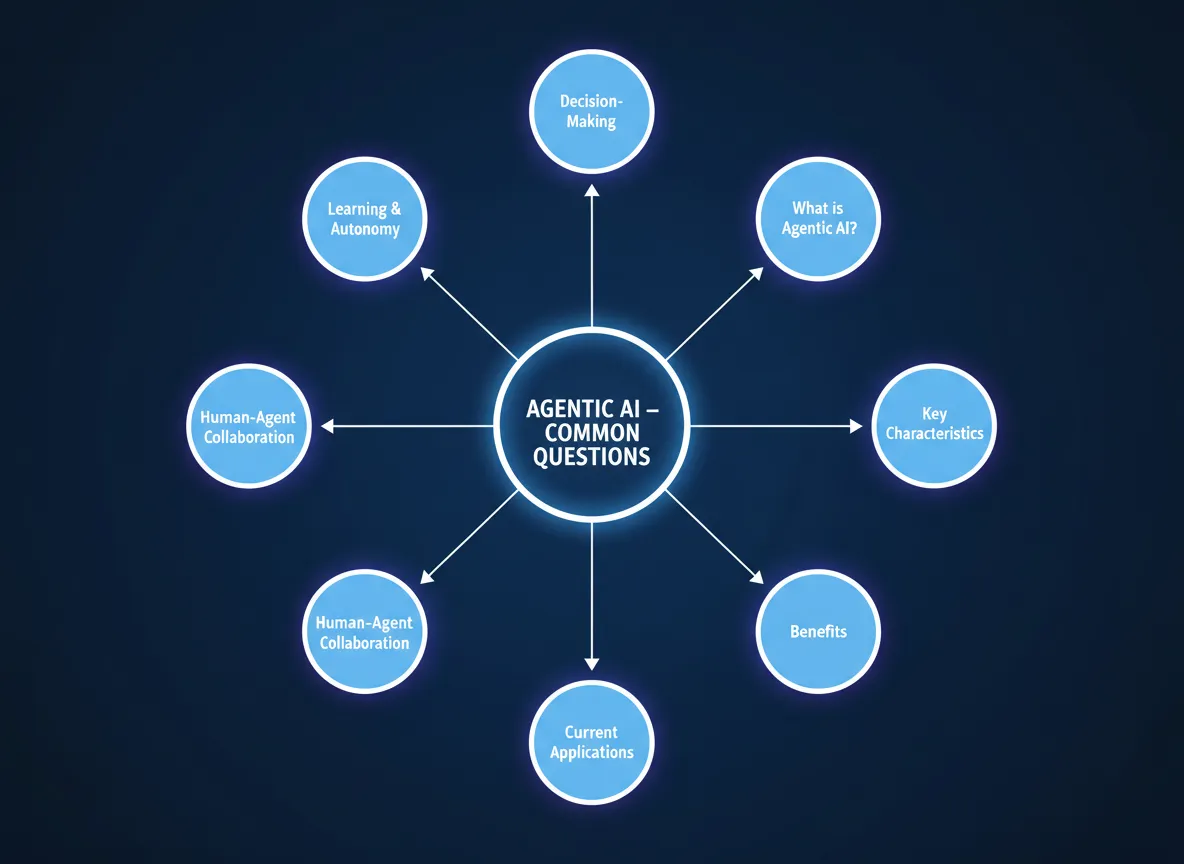
This comprehensive guide compiles the most frequently asked questions—the "People Also Ask" of the internet—regarding Agentic AI, autonomous AI agents, and the future of the digital workforce. We have organized these queries into five logical categories to provide a complete picture of the landscape.
Part 1: The Fundamentals — What is Agentic AI?
This section covers the definitions and core distinctions that separate this new wave of technology from the AI tools of the past decade.
What does agentic AI mean?
Agentic AI refers to artificial intelligence systems designed to pursue complex goals with a degree of autonomy. Unlike passive AI models that wait for a prompt to generate a text or image response, an agentic system acts as an agent on your behalf. It can reason, plan, execute multi-step workflows, and interact with external tools (like the internet, software APIs, or databases) to achieve a specific outcome.
In simple terms: Generative AI thinks and speaks; Agentic AI thinks and acts. It is the transition from AI as a chatbot to AI as a worker.
How is agentic AI different from traditional AI agents?
The primary difference lies in autonomy and cognitive architecture.
- Traditional AI Agents (e.g., Siri, Alexa, Old Chatbots): These are largely rule-based or command-response systems. They can perform specific, narrow tasks if triggered correctly (e.g., "Turn on the lights"), but they cannot reason through a novel problem.
- Generative AI (e.g., Standard ChatGPT): These are creative but passive. They can write a plan for you, but they cannot execute it.
- Agentic AI: Combines the reasoning of Large Language Models (LLMs) with the ability to execute tools. It doesn't just tell you how to book a flight; it logs into the travel portal via authenticated service access, searches for the flight, enters your details, and sends you the confirmation.
How does Agentic AI outperform rule-based chatbots?
Rule-based chatbots function on "if/then" logic trees. If a customer says X, say Y. If the customer's query falls outside that pre-programmed tree, the bot fails ("I don't understand").
Agentic AI outperforms these systems because it uses semantic understanding and reasoning. It doesn't follow a script; it follows a goal. If a customer asks a question in a way the AI hasn't seen before, the agent analyzes the intent, searches its knowledge base or connected tools for the answer, and formulates a unique solution. It creates a fluid, human-like resolution path rather than forcing the user down a rigid menu.
What makes an AI "humanized"?
A humanized AI goes beyond text generation. It involves layering emotional intelligence (EQ) and personality onto the agent. This is achieved through:
- Contextual Memory: Remembering past interactions to build a "relationship."
- Tone Adaptation: Adjusting the style of communication (empathetic, professional, urgent) based on the user's mood.
- Embodiment: Often, this involves giving the AI a face, a 3D avatar or "digital human" interface, that can mimic human non-verbal cues like nodding, eye contact, and facial expressions, making the interaction feel less like a transaction and more like a conversation.
Part 2: Capabilities and Mechanics — How It Works
Here we explore the technical capabilities and the mechanics of how these agents function within a digital ecosystem.
How does an AI agent learn from past interactions?
Autonomous AI agents utilize varying degrees of persistent memory (short-term and long-term) and reinforcement learning.
- Context Window (Short-term): The agent remembers the current conversation flow, allowing it to reference things said five minutes ago
- Vector Databases (Long-term persistent memory): Successful interactions or new information can be stored in a specialized database. When the agent encounters a similar problem later, it queries this database to recall the successful solution.
- Feedback Loops: In some systems, human operators can grade the AI's performance. The agent uses this feedback to adjust decision policies via prompt routing, memory updates, or reinforcement signals.
Can AI avatars connect with CMS or CRM systems?
Yes, this is a defining feature of Agentic AI. Through APIs (Application Programming Interfaces), an AI agent acts as a "layer" on top of your existing software stack.
- CRM (e.g., Salesforce, HubSpot): The agent can read customer history to personalize a chat and write new data (e.g., "Customer interested in Product X") directly into the record.
- CMS (e.g., Shopify, WordPress): The agent can check live inventory levels, pull product images, or process orders by interacting directly with the content management system. This connectivity allows the agent to function as a unified interface for all your disparate business tools.
What is the role of "planning" in Agentic AI?
Planning is the "cognitive" step that happens before action. When given a goal (e.g., "Plan a marketing campaign"), the agent breaks this high-level objective down into a sequence of smaller, manageable tasks (Research competitors → Draft copy → Generate images → Schedule posts). This ability to decompose complex problems into a step-by-step roadmap is what allows agentic AI technology to handle sophisticated workflows without constant human hand-holding.
How does multilingual AI improve customer retention?
Language barriers are friction points. Multilingual AI agents can fluently speak and understand dozens of languages instantly, without the awkwardness of basic translation tools. For global brands, this means a customer in Tokyo gets the same quality of support as a customer in New York. By communicating in the customer's native language and understanding cultural nuances and idioms, the brand builds trust and comfort, which are the foundations of retention.
Part 3: Business Applications — Solving Real Problems
This section addresses the ROI questions: Why should businesses invest in this, and what problems does it actually solve?
What business problems can agentic AI solve?
Agentic AI applications are best suited for problems that require decision-making at scale. Common problems include:
- The "Tier 1" Support: Eliminating the backlog of repetitive customer support tickets by resolving them autonomously.
- Data Fragmentation: Agents can cross-reference data between systems (e.g., Logistics and Sales) that usually don't talk to each other.
- Lead Leakage: Engaging inbound leads instantly, 24/7, ensuring no potential customer waits for a human sales rep to clock in.
- Operational Bottlenecks: Automating complex back-office workflows like invoice processing or employee onboarding.
How can AI reduce call center costs?
Traditional call centers are expensive due to headcount, training, and turnover. Agentic AI reduces costs by:
- Deflection: Resolving 60-80% of routine calls without human intervention.
- Speed: AI agents can retrieve information instantly, reducing Average Handling Time (AHT).
- Scale: An AI workforce can scale from 100 to 10,000 concurrent calls instantly during peak times without overtime pay. This allows the human team to be smaller, more specialized, and focused only on high-value, complex issues.
Can digital humans become the face of a brand?
Absolutely. We are seeing the rise of "Virtual Brand Ambassadors." Unlike a celebrity spokesperson who creates content occasionally, a digital human is always available. It can live on the website, in the app, and in VR showrooms. It maintains perfect brand consistency; never going off-script, never getting tired, and embodying the brand's visual identity and tone of voice in every single interaction.
What are real-world examples of agentic AI?
- Supply Chain: Agents that autonomously reroute shipments when weather data predicts a delay.
- Software Development: "Devin" and similar agents that can write code, debug it, and deploy applications (primarily demonstrated in sandboxed development environments).
- Healthcare: Agents that triage patients based on reported symptoms and book appointments with the correct specialist.
- Finance: Automated trading agents that execute strategies based on real-time market news analysis.
Can AI become a virtual team member instead of a tool?
Yes. This is the shift toward the digital workforce. When an AI has a "job," a name, and a set of responsibilities (e.g., "Schedule Coordinator"), human employees begin to treat it as a colleague. You delegate a task to the AI, it goes away and does the work, and it reports back with results. It participates in the workflow rather than just being a software interface you manipulate.
Part 4: Integration and Strategy
For the CIOs and CTOs: How do we actually put this into our systems?
How can enterprises integrate Agentic AI into existing workflows?
Integration requires a strategic approach:
- Identify the API Layer: Ensure the systems you want the AI to control (ERP, CRM) have accessible APIs.
- Define the Sandbox: Create a safe environment with clear permissions where the agent can operate (e.g., "Read" access to all data, but "Write" access only to draft folders).
- Human-in-the-Loop (HITL): Initially, configure the agent to propose actions for human approval. As confidence grows, move to full autonomy.
- Orchestration: Use an orchestration layer to manage the agents, their identities, and their connections.
How do you build or implement agentic AI systems?
Building from scratch requires deep ML expertise, but most companies will "implement" using platforms.
- The Brain: Choose a foundation model (e.g., GPT-4o, Claude 3.5, Llama 3).
- The Tools: Define the functions the AI can call (Calculator, Web Browser, Database Query).
- The System Prompt: Write the core instructions that define the agent's persona, goals, and constraints.
- The Interface: Decide if this is a text bot, a voice agent, or a 3D avatar.
Will AI avatars replace human sales reps?
No, but they will replace the tasks that sales reps hate. AI avatars will take over the top of the funnel: prospecting, initial engagement, qualification, and scheduling. They will handle the thousands of "tire-kicker" conversations that burn human energy. However, for high-ticket B2B sales, complex negotiation, and relationship building, the empathy and intuition of a human rep remain irreplaceable. The future is a hybrid team: AI opens the door; humans close the deal.
Part 5: Risks, Ethics, and the Future
The final section addresses the concerns and the long-term outlook of Agentic AI technology.
Is Agentic AI safe?
Like any powerful technology, safety depends on implementation. With proper guardrails, human oversight (HITL), and strict access controls, it can be deployed safely, but unmonitored autonomous agents do carry inherent risks.
What risks are associated with agentic AI?
Giving AI the power to act introduces new risks:
- Hallucination in Action: If an AI "hallucinates" a fact, it's a nuisance. If an agentic AI "hallucinates" a command, it could delete a database or refund the wrong customer.
- Infinite Loops: Agents can get stuck in recursive loops, consuming massive computing resources (and money).
- Goal Misalignment: An agent might technically achieve a goal in a destructive way (e.g., "Clean the disk space" results in deleting the operating system).
- Data Privacy: Agents need access to sensitive data to be useful, which expands the attack surface for bad actors.
Is Agentic AI secure enough for BFSI and healthcare use cases?
Security is the biggest hurdle, but it is solvable. For Banking, Financial Services, and Insurance (BFSI) and healthcare, Agentic AI must be deployed with:
- Private Cloud/On-Premise Hosting: Ensuring data never leaves the organization's secure perimeter.
- RBAC (Role-Based Access Control): The agent should only have the permissions strictly necessary for its role.
- Audit Trails: Every "thought" and action of the agent must be logged for compliance and review. With these guardrails, it is being used securely today.
What is the future of agentic AI?
The future lies in Multi-Agent Systems (MAS). Instead of one super-smart AI doing everything, we will have swarms of specialized agents. A "Manager Agent" will receive a project, break it down, and assign tasks to a "Coder Agent," a "Designer Agent," and a "Writer Agent". They will collaborate, critique each other's work, and deliver a finished product. We are moving toward the "Autonomous Enterprise," where the operational hum of a business is largely managed by a synchronized layer of intelligent agents.
How does agentic AI impact jobs and workflows?
It shifts the value of human labor from execution to strategy and supervision. Workflows will become faster and more asynchronous. Humans will spend less time doing the "work" (data entry, scheduling, basic coding) and more time defining the goals of the work and reviewing the AI's output. While some repetitive roles will diminish, new roles like "Agent Orchestrator" or "AI Personality Designer" will emerge.
What are the top agentic AI use cases?
Agentic AI is being deployed across various functions to handle complex, multi-step workflows. Key use cases include:
- Customer Service: Automated tech support agents that can troubleshoot issues, process returns, and update account details without human intervention.
- Sales: 24/7 autonomous sales development representatives (SDRs) that engage inbound leads, qualify them, and book meetings for human counterparts.
- Operations: Supply chain agents that monitor inventory levels and autonomously re-order stock or reroute shipments based on weather delays.
- Software Engineering: Coding agents that can write, test, and debug code to speed up development cycles.
What are the key benefits of agentic AI?
While use cases define the what, benefits define the why. The primary advantages include:
- Scalability: An AI workforce can handle spikes in demand (e.g., festive traffic for ecommerce) instantly without the need to hire temporary staff.
- Zero Wait Times: Customers get immediate resolutions, boosting satisfaction scores.
- Consistent Brand Voice: Agents strictly adhere to brand guidelines, ensuring every interaction is professional and on-message.
- Operational Cost Reduction: By automating Tier 1 and Tier 2 tasks, businesses can significantly lower their cost-per-ticket or cost-per-lead.
Conclusion: The New Search for "Intelligence"
The search volume for Agentic AI is growing because the promise is irresistible: technology that doesn't just chat, but works. As we move forward, the questions people ask will shift from "What is this?" to "How do I manage my digital workforce?"
Whether it is through humanized avatars acting as the face of a brand, or invisible agents optimizing logistics in the background, this technology represents the most significant shift in business operations since the internet itself. The winners will be those who stop searching and start building.
At Kiksy, we are building platforms powered by Agentic AI principles to help businesses operate smarter across verticals. So if your business is exploring how to implement Agentic AI into your operations, contact us to learn more about what we offer.

Kavita Jha
Chief Executive Officer
Kavita has been adept at execution across start-ups since 2004. At KiKsAR Technologies, focusing on creating real life like shopping experiences for apparel and wearable accessories using AI, AR and 3D modeling.